
Karachi Office
- M-51, Muneer Mobile Mall, Block 17, Near Perfume Chowk & Jauhar Chowrangi, Gulistan-e-Jauhar.
- info@site.courtmarriagelaw.com
- +92 316-6644789
Muslim Nikah marriage step by step begins with lawful intention, free consent of both parties, the presence, determination of Mehr, and solemnization of marriage through offer and acceptance in one sitting. In Islam, Nikah is both a sacred covenant and a legally recognizable marital contract. A proper Nikah must satisfy religious essentials while also meeting legal documentation requirements where registration is intended.
Through our marriage law platform affiliated with Qanoon Group, Nikah matters are explained from practical legal and matrimonial experience developed over nearly 40 years of marriage documentation and family law practice.
📍 Visit Our Office:
Munir Mobile Mall, Near Perfume Chowk, Block 17, Gulistan-e-Johar, Karachi East 75290
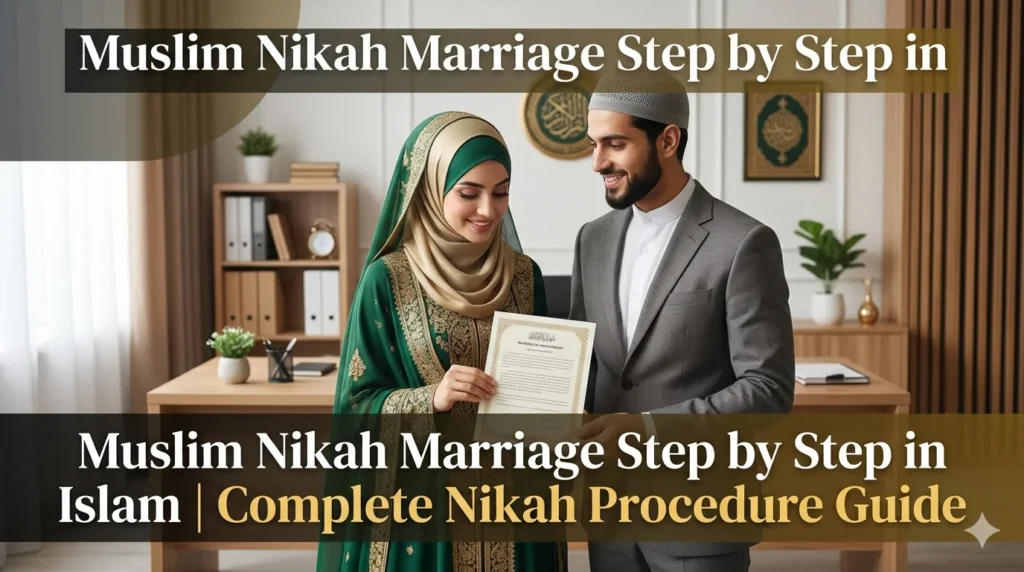
Nikah in Islam is a lawful marriage contract entered into through mutual consent between the bride and groom in the presence of witnesses.
It is not merely a social ceremony.
It creates:
For Muslims, Nikah carries both religious and legal significance.
Step | Islamic Requirement |
1 | Proposal and willingness |
2 | Consent of the bride and groom |
3 | Determination of Mehr |
4 | Presence of witnesses |
5 | Offer and acceptance (Ijab-o-Qubool) |
6 | Khutbah and Dua |
7 | Signing of Nikah documents |
This sequence remains the practical foundation of Muslim marriage.
Nikah begins with a clear lawful intention.
The marriage proposal may come directly or through family representatives.
Islam emphasizes sincerity and lawful purpose at the beginning of marriage.
Without genuine consent, Nikah loses validity.
Consent is essential.
The bride and groom must independently accept the marriage.
Forced marriage is not valid under Islamic principles.
The bride’s acceptance must be clear and free.
Mehr is the financial right of the bride.
It is given by the groom and becomes her independent entitlement.
Mehr is not symbolic only; it creates enforceable legal entitlement.
Witnesses remain necessary for Sunni Nikah.
Under Pakistani legal practice, witnesses are required for Nikah/marriage registration as well.
This is the central moment of Nikah.
The offer and acceptance must occur in one sitting.
The bride or her representative accepts.
Groom accepts clearly.
This creates the marriage contract.
A short Nikah sermon is usually delivered.
This reminds the couple of:
Dua follows for blessings.
After solemnization, Nikah documentation is completed.
Nikah Nama becomes the primary documentary proof of marriage.
The Wali represents protective family oversight, especially in traditional Islamic practice.
Under Pakistani Muslim marriage practice, adult Muslim women may contract marriage themselves, though family representation often remains socially common.
Requirement | Position |
Consent | Mandatory |
Mehr | Mandatory |
Witnesses | Mandatory |
Offer and Acceptance | Mandatory |
Documentation | Strongly required for legal proof |
Nikah itself creates a marriage religiously.
Registration strengthens civil proof.
Islam deliberately keeps Nikah simple.
But legal consequences are serious because marriage creates:
That is why proper documentation remains wise.
Walimah is recommended after marriage.
It is not a condition of Nikah validity.
It remains a Sunnah celebration of lawful union.
llus, luctus nec ullamcorper mattis, pulvinar dapibus leo.
Many people focus only on the ceremony and ignore documentation.
Years later, this creates difficulty in:
Nikah is one of the most dignified contracts in Islam because it combines faith, responsibility, and lawful companionship.
A properly completed Nikah protects both spiritual and worldly rights.
WhatsApp us